
How to Choose Ejector Pin Material for Injection Molds — SKD61 vs SKH51 vs High-Speed Steel
Engineering comparison of SKD61 (H13), SKH51 (M2), and nitrided steels for plastic injection mold ejector pins. Thermal fatigue resistance, surface treatment, and thin-pin anti-buckling design.
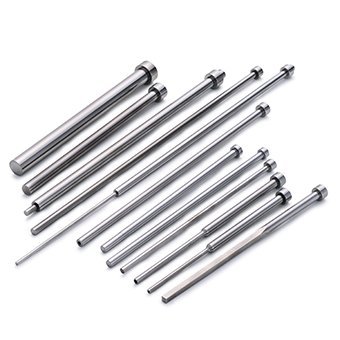
Ejector pins are the most heavily cycled mechanical components in plastic injection molds, undergoing continuous high-velocity reciprocating motion, frictional wear, and direct thermal shocks from molten resin. Selecting the incorrect grade of tool steel frequently leads to pin seizure, galling, surface flash on molded parts, or catastrophic fatigue failure.
1. SKD61 (JIS) / AISI H13 / DIN 1.2344 — The Universal Workhorse
SKD61 is a chromium-molybdenum hot-work tool steel and remains the global baseline choice for over 80% of standard injection tooling:
- Dual Heat-Treatment Architecture: Through-hardened to HRC 38–42 in the core to preserve flexible toughness, then vacuum ion-nitrided on the surface to achieve a micro-hardness of HV 950–1100 (equivalent to HRC 68–72).
- Thermal Shock Resistance: Excellent resistance to thermal cracking and softening at mold operating temperatures up to 550°C.
- Best Suited For: General-purpose engineering resins (PP, PE, ABS, PC, PA6) in standard cycle times.
2. SKH51 (JIS) / AISI M2 / DIN 1.3343 — High-Speed Steel for Severe Duty
SKH51 contains significant tungsten, molybdenum, and vanadium alloys, offering dramatically enhanced compressive strength and hot hardness:
- Uniform Through-Hardness: Heat-treated to a uniform HRC 60–64 across both surface and core without relying on a thin nitrided crust.
- Anti-Deflection Rigidity: Possesses a high Young's modulus, preventing elastic deflection when ejecting deep-rib or high-drag optical moldings.
- Best Suited For: Small diameters (≤ Ø2.5 mm), glass-fiber reinforced abrasive polymers (PBT+30%GF, PPS, LCP), and fast-cycling multi-cavity medical molds (e.g., syringe barrels).
3. Comprehensive Material Comparison Table
| Steel Grade | Core Hardness | Surface Hardness | Max Operating Temp | Primary Advantages |
|---|---|---|---|---|
| SKD61 (Nitrided) | HRC 40–45 | HV 950–1100 (~HRC 70) | 550°C | High core toughness, anti-seizure, cost-effective |
| SKH51 (HSS) | HRC 60–64 | HRC 62–65 (Through-hard) | 600°C | Superior wear resistance, zero edge-collapse on small pins |
| SUS440C (Stainless) | HRC 54–58 | HRC 56–60 | 250°C | Corrosion-proof for cleanroom medical & PVC tooling |
4. Solutions for Thin Pin Buckling & Fracture
When ejector pin diameters fall below Ø2.0 mm with stroke lengths exceeding 50 mm, straight pins often buckle under high release pressure.
CUSTOM DRAWING FABRICATION · FAST RFQ
Need a Precise Quote for Custom Mold Components?
YZX Precision specializes in tight-tolerance punches, ejector pins, and guide sets holding ±0.002mm. Upload your STEP, DWG, or PDF drawing for a rapid quotation within 2 business hours.
 Chat on WhatsApp